Showing posts with label Composition. Show all posts

Wednesday, November 6, 2013

Creating a Silver Coin for the Royal Canadian Mint

It has been a year since I was commissioned by the Royal Canadian Mint to design and produce a painting for a 20 dollar silver coin.  Now that the official release has finally arrived, I can take the wraps off of the art and tell the story behind the project and the painting that I created!

It all began in October, 2013 when a product manager at the Mint came across one of my hockey paintings on rdewolfe.com and decided that this was something they would like to see on a Canadian collector coin.  I was then contacted and commissioned to come up with a new design featuring Canadian children playing the much loved game of pond hockey.

The production work for a new coin is long and arduous, so it was imperative that I immediately begin working out the design for the new coin.  Country, kids and hockey are favourite subjects of mine, so I eagerly began working on the project.  Sketches were soon approved and painting commenced!

Original sketch for Pond Hockey painting

The first sketch was received with enthusiasm but because it was decided to reproduce the background buildings in bas-relief rather than full colour, it was necessary to separate the figures in the foreground from the objects in the distance.  I submitted a new drawing that was then deemed perfect for the job!

Final sketch for Pond Hockey painting

Once I received final approval for the drawing, I transferred it to canvas to begin the painting.  The next step was to apply a thin blue wash overall to create a 'cool' atmosphere.


Now I begin painting in dark areas using acrylic paint for speedy drying.  This allows me to move forward quickly.


When I begin adding local colour throughout the painting, things start to come together.  At this point I have switched to alkyd oil paint.


Now I add in colour and texture on the ice surface and the background scene.  All the basics are there, so now it is a matter of finishing up by adding more colour and detail to the painting.  Originally, I intended to do a circular painting as indicated by the initial painting of the sky.  In the end, however, I decided it would be more attractive to extend the scene into a square format, resulting in a more complete, square painting.

Finished painting "Pond Hockey" 

And here it is....the finished one ounce silver coin, available for purchase at themint.ca or one of the dealers listed on their web site, including Canada Post Corporation.  One of the really neat features of this limited edition silver coin is the full colour treatment, making it a very unique collectible!


Wednesday, August 14, 2013

Iris Garden

This is another painting that I did recently as a demonstration during an acrylic painting class.  The iris is one of my favourite flowers and my wife and I grow them in our perennial gardens on our farm.  I love the combination of blues, purples and yellows that are so common in these tall, majestic flowers.  It is a pity that they bloom for such a short time.

'Iris Garden' by Richard De Wolfe
12 X 9 acrylic on panel


We work quickly in these painting classes as I explain the method while I demonstrate the techniques. At the same time, I try to assist my students with their work, with the goal of helping them successfully complete their painting by the end of each two hour class.


The first step is to loosely place the main objects on the canvas with light pencil lines, just indicating the general shapes.  This way, you have not invested much time in the drawing before you are sure that the placement is what you want.


When you are happy with the placement of the general flower shapes, it is time to refine them, adding basic detail to the petals.  Do not 'over draw' the flowers.  There is no need to labour over excessive detail that would be obliterated when you begin to paint.  Don't get too rigid with outlines either. This way you will not become a slave to lines you have drawn on the canvas.  These are guidelines only!


Now we mix up the basic flower colours and paint the general flower shapes with a large brush.  Some effort is made to preserve most of the construction lines that separate different areas within the flower petals.


Now we add a general background colour using a broad brush and lots of expression in the brush strokes.  Avoid making the background flat and boring.  Give your brush work life and energy.  I use a deep blue and green mixture to emphasize the bright flowers in the foreground.


The next step is to add leaves and stems, again using a large flat or filbert brush.  I mix a warmer, lighter green and apply it in simple, direct strokes.  My goal is to create an interesting and balanced design to support the colourful flowers that are the focal point in the painting.


Now we add darker and lighter variations of the stem and leaf colour, creating a pattern of light and shadows that is consistent throughout the painting.  This allows us to also create an illusion of depth, with leaves and stems overlapping each other and dropped shadows under the flower petals to bring them into the foreground.


We turn our attention to the flowers themselves and add light areas to the basic petal shapes to give them form and detail.  This is done carefully, keeping the light source consistent with our previous work.


In the final minutes of the class, we add deep, rich variations of colour to the flowers.  White highlights are applied sparingly to catch the viewer's eye and hold their attention in a tasteful and not too obious a manner.  Any last minute corrections or additions are made and the signature goes on.  Voila!  Fini!

Thursday, April 18, 2013

Winterlude Part 3

"Winterlude" almost there!

I keep adding colour and detail throughout the entire scene.  I want to maintain a balance so that I can judge each new brush stroke against the overall look of the painting.  If you concentrate too much on one area you may find that it doesn't work so well after the rest of the painting is completed.  You also run the risk of 'falling in love' with how that particular area of your work looks and you may not want to make necessary changes as you go forward.  By working more or less equally across the painting, you can maintain a healthier and more impartial perspective on your work.

Here I have painted in the distant trees using a mixture of sap green, ultramarine blue and titanium white.  Ultramarine blue dominates to create an illustion of distance.  Now the local colour of the barn is introduced.  I decided on a soft yellow to promote the feeling of bright sunlight on a cold winter day. I add snow to the branches of the spruce tree in front of the barn and generally add more detail to everything.  I introduce a slight hint of warmth in the sky on the right side of the painting, again to establish a feeling of bright sunlight coming from that direction.  Now I embellish the soft shadows in the snow and on the snowy branches in the foreground using a mixture of ultramarine blue and titanium white.

"Winterlude" 9 X 12 inches acrylic on board


I work fairly consistently over the entire painting as I go along, so everything comes together quite nicely as I near the finish.  I add small details and highlights as necessary, such as brightening the snow on the barn roof, spruce tree, fence and middle ground to suggest bright light in these areas.  I add bits of snow in the forks of tree branches beside the barn and I strengthen the blue shadow areas.

The last area to concentrate on is the foreground.  Layers of detail and colour are added to the birds to make them appear close to the viewer.  The pine needles are finished off with darker and more detailed brush strokes using a combination of sap green and lamp black,  The tree branches are painted in quickly with burnt sienna and lamp black in the shadows.

In order to increase the contrast between the sunny background and the shadowed foreground, I add a glaze of ultramarine blue and mat medium over most of the pine branches and the birds until I see a clear division between the two areas.  Once the signature is added, the painting is finished!


Wednesday, January 23, 2013

Winterlude

"Winterlude" sketch

I thought I would do a demo of how I paint this Christmas image for licensing.  I do a fair amount of illustrative art for licensing through Porterfield's Fine Art Licensing.  A winter scene is the perfect choice, since the art that is most in demand for licensing is usually a Christmas theme.  These images are often used for greeting cards, puzzles, gift ware and paper products as well as many other possibilites.  A prospective client will review the work I have available for licensing in a given catagory, choose what suits their project and purchase limited rights to use the image for a specific purpose and for a specific period of time.

The first thing I do when producing this type of art is to brainstorm an idea that will appeal to a maximum number of buyers.  Quite often, as in this case, the idea includes a number of similar images that may evolve into a series of finished pieces, all on the same theme.  Once I feel I have enough inspiration to proceed I come up with reference material for my idea.  I file all types of reference and I take digital photos everywhere I go, so I have a lot of material to draw from.  Now I create sketches to work out my design and create any additional parts of my picture from a combination of memory and imagination.  When this is done  I proceed to do a finished sketch on board or canvas to begin my painting.

"Winterlude"

The next step begins by spraying my drawing with a workable fixative to seal the graphite and prevent smearing.  Now I cover the drawing with matt medium that contains a small amount of acrylic pigment to tone the board.  Usually I will mix one muted colour and cover the entire surface evenly to provide a ground instead of glaring white.  Warm earth tones are my usual choice, but blue-gray is an alternative for a cooler, more subdued look.  

This time I wanted to suggest an extreme contrast between the extreme sunlight on the right and the cool shade on the left of my painting, so I toned the matt medium with cadmium yellow on the right and cerulean blue on the left.  I hope to create the illusion of a winter day warmed by the sun.  These colours will influence the paint that I lay over top as I continue to work.

Sunday, December 30, 2012

Vignettes

Every picture does not have to be a full blown painting.  Sometimes a simple little drawing is a nice change from complicated compositions, colour schemes and well thought out story lines.  At times, just a centre of interest on a blank background can be enough to make a very satisfying picture.

"Downey Duo" Acrylic on Paper  3.5" X 6"  


These little paintings might be done as colour sketches for a painting idea or maybe to try out a different style or technique.  Other times they may be 'just for fun'!
"Little Filly" India Ink on board 6" X 6"


I used to do a lot of pen and ink drawings as commercial illustrations.  It is a lot of fun and I think it would be nice to do them more often.  This little sketch was done as a study of a new foal that one of our mares delivered some years ago.  It can be challenging to try to create the illusion of light and shade, tone and texture using only a simple black line on a white background but the results can be very rewarding and fresh.

Creating small, simple pictures like this is a great exercise that doesn't have to take a long time to complete.  It is a great way to capture an impression or likeness of something or someone when time is short or ideas are coming fast and furious!  For an art lover on a tight budget, it could represent an opportunity to own a piece of original art, sometimes for less than the cost of a print.


Tuesday, October 23, 2012

Autumn Colour

This is a wonderful time of year in southern Ontario.  The deciduous trees are transformed from faded green of late summer to a palette of reds, yellows, browns and gold.  Set against the deep green of red pine and spruce, colours 'pop' and the landscape takes on a new and awesome look.   With visual stimulation such as this,  landscape painting is the number one priority for me.  I love to get out on a warm sunny day in fall and either spend a few hours making quick oil sketches or just moving around, recording everything I can with my digital camera.  These images often result in larger works back in the studio.  When the cold winter winds blow heavy through rattling, frozen tree branches, creating a rich autumn landscape painting in a warm studio is high on my list of 'things to do'.

 "A Bend in the Road" available for sale at: http://tinyurl.com/9eey8zl


This little painting measures 6 X 8 inches.  It was done a little earlier in the season when the leaves were just starting to change.  I think if I eventually do this in a large painting, I might add a figure in the distance.  What would you do?

"Dry Marsh"  available for sale at: http://tinyurl.com/9z2uf92

This is another small painting I did this fall.  'Dry Marsh' measures 6 X 9 inches.  I like the depth of field in this one and the distant blue trees against the golden grasses of the marsh.  This type of landscape is common in this area.


Sunday, February 26, 2012

On Stoney Batter Road Finished


At this stage I have blocked everything in and I can judge the final look of the painting.  If I am unhappy with how things are going, it is easy to make changes at this point.  If you have an area in a painting that you have spent a great deal of time on trying to make it 'just right', it can be heart breaking and difficult to bring yourself to make necessary changes.  It is usually better to leave 'finished work' until last!


It is nice to get to this stage and begin adding detail and subtilties to the painting.  I like alkyd because it dries quickly but not so quickly that you have difficulty blending one colour into another.  Working from back to front, I add more mist coming through the distant trees.  Next, a little more detail in the middle ground.  The last thing I do at this point is add colour and light on the birch tree in the foreground.


Now I turn my attention to the split-rail fence, adding colour and light to define the weathered surfaces.  The fence makes a great lead-in for the viewer's eye.  The composition is designed to stop the eye at the birch tree, move up the trunk and follow the limb near the top of the picture to the trees in the middle ground.  The gentle slope of the rough fields brings the viewer's eye back to the birch tree and weathered fence.


The final step involves adding a little more colour to the foliage of the trees in the middle ground, more definition to the leaves and branches of the birch tree, the fence and the foreground grasses.  The whole painting is completed in a little over an hour.

Monday, June 20, 2011

Freighter Inviken-Step 6

The final phase of the painting is a matter of going back and refining areas as needed.   The clouds are softened a little and white highlights are added to indicated the direction of the sunlight filtering through them.  The trees and bridge are painted in and if you look close, you will see a tiny tractor-trailer truck at mid-span.  Small details are added over the superstructure of the ship and the hull is embellished to make it look powerful.  I add layers of colour over the small waves and reflect the sunlight with an impressionistic application of white highlights.

The last thing I do is add my signature to the lower right hand corner.  This last image is a professional scan of the finished painting and is a better representation of the true colours in the painting.  As I work, I take digital photos on my easel where the light is not as balanced as it should be, so the initial images can be less acurate.

I wanted to create a painting that suggests power and industry, while at the same time indicating the power and majesty of the natural world.  When I finished, I was pleased with this result.  The painting measures 16 inches high by 20 inches wide, painted on stretched canvas.  If you are interested in purchasing this original work of art or a fine art print on archival paper or canvas, please visit my website at www.richarddewolfe.com.

Tuesday, June 14, 2011

Freighter Inviken-Step 5

It is finally time to start blocking in the ship itself.  This is a complex shape with many small details.  I take my time, painting in sections simply and as clearly as I can.  The mass of the hull is mostly black with only slight suggestions of form and contour at the rear and away from the sunlight.  On the right side of the ship, where the light is strong, I try to suggest heavy steel plates that are streaked with rust.

The superstructure of the freighter is much more complicated and each area requires careful consideration.  I keep the surfaces that are away from the sunlight cool and subdued and begin playing up the surfaces that face the sun.  This creates the center of interest in the painting.  Everything is now more or less in place and working together.

Thursday, June 9, 2011

Freighter Inviken-Step 4

I begin blocking in the clouds now.  I start with the darks, establishing the weight and mass of the cumulus formations.  When I placed the general cloud masses in the sky, I drew them in perspective,  going from large shapes in the foreground above the ship and progressively getting smaller as you look further back and down towards the distant horizon.

Now I begin refining the darks in the clouds and adding mid tones to soften and mold these areas.  I work progressively lighter, leaving the brightest highlights until last.  Now I have established the general look of the sky, with only the ship itself to be blocked in.  The overall look of the painting is beginning to make me want to get back out on the water myself!

Tuesday, May 31, 2011

Freighter Inviken-Step 3

I continue to build simple colours in the water, the headlands and the bridge that is back near the horizon.  Already the ship seems to be sitting on the surface of the water and moving towards the bridge.

I add more detail to the trees and then spend more time building subtle colour shifts in the surface of the water.  Each wave is a separate surface.  Each of these surfaces is concave in shape, so light is reflecting off of them in a multitude of angles and intensities.  Everything is in continuous motion, so I find the best way to paint water is to recreate the impression it gives you rather than trying to sort out specific details.  I work over this surface a number of times, occasionally adding a thin glaze with one colour to unify everything if it gets too busy.

Saturday, May 28, 2011

Freighter Inviken-Step 2

Now I create a tonal image on the canvas, using progressively darker mixtures of my ground colour.  This gives me a feel for the tonal balance in the painting.  In other words, I can assess where the lights and darks will fall and what sort of positive/negative design this will create in the finished work.

Now it is time to switch from acrylic paint to alkyd.  I usually block in the sky first, working from dark to light and distance to forground throughout the painting.  I have painted the sky a darker shade towards the zenith and becoming progressively lighter towards the horizon.  I also keep the sky lighter on the side towards the light of the sun and darker on the opposite side.  As you can see by the light side of the ship, the sunlight will be on the right side of the painting.  I avoid getting to fussy or detailed at this stage.

Wednesday, May 25, 2011

Freighter Inviken

It is the beginning of boating season here in the Thousand Islands area on the St. Lawrence River.  I love the water and boating, and soon I will be launching my own craft once again.  The St. Lawrence Seaway has been open to shipping for several months now and will remain open until late autumn, alllowing ships from all over the world to reach ports all around the Great Lakes, deep in the interior of Canada and the United States .

This is a freighter from Europe that I saw several years ago as it was approaching the Thousand Island Bridge, between the U.S. mianland and Wellesley Island, N.Y.  I loved the powerful mass of the ship, rising off of the water like some displaced, highrise architecture.  I found the persepective leading to the arch span of the bridge in the distance to be an interesting design that appealed to me.  The rolling clouds overhead seemed to enforce the energy and power of the massive ship churning upstream to Toronto, Detroit  and perhaps  many ports beyond.

Once I had worked out the composition to my satisfaction, I transferred the drawing to a 16" X 20" stretched canvas.  The next step was to spray the drawing with fixative to prevent smearing when I started to paint.

After fixing the canvas, I applied a mixture of matt medium, burnt umber and cadmium red, to create a warm, earthy ground.  This acrylic mixture is mostly matt medium to maintain a high degree of transparency so that my pencil drawing remains very visible.  The warm colours will be complimentary to the cool blues of this waterscape.  At this stage I am always eager to see some local colours applied to this ground.

Tuesday, April 26, 2011

Across the Miles - Step 5

I have now blocked in the entire canvas with colour.  Finishing the snow-cover changes the mood and the look of the painting quite drastically. This gives me a really good idea of how the finished painting will look.  The contours, light and shadows in the snow requires a subtle touch.  It is important to create the illusion of an undulating plane, falling away from the foreground to the mountains in the distance.  The roadway must also appear to 'sit' into the snow rather than on top of it.  The fence now appears to stand up from the snow, three dimensionally.

Painting and refining the white lettering on the side of the postman's sleigh is meticulous work and requires patience.  There is more work in this painting than I expected!

Monday, April 18, 2011

Across the Miles - Step 4

I continue the process of painting from back to front.  I render the barn in the distance, then proceed to the farm house in the middle ground.  Once again, I am choosing warm colours to keep this winter picture from becoming too 'cold'.

The next thing I tackle is the horse pulling the mail sleigh.   This is a critical element in the painting, essentially the center of interest so I must take great care in how I paint it.   I choose to make the horse black to create a high contrast with the white snow around it.

At this stage, I have left out the snow in the middle ground and started blocking in basic colour and detail on the rail fence in the foreground.  This helps me to keep a visual balance throughout the painting.  I have included the rail fence in the composition in order to add 'weight' to the lower portion and to guide the eye back toward the center of interest.

Sunday, April 10, 2011

Across the Miles - Step 3

Usually I like to do a quick underpainting with acrylics on top of my toned canvas, but occasionally I will start to paint directly on a toned and shaded drawing.  I have decided to take the latter approach this time, starting from the sky at the top (furthest away from the viewer) and working my way down and progressively closer to the viewer as I go.  This allows me to build an illusion of depth into the work.

To keep the work from being too 'cold', I add warm yellows and pinks to the clouds, suggesting late-day lighting from the left.  I block in the snow-covered hills and move forward through the heavily laden spruce trees.  The last thing I do at this stage is to begin adding more form and colour to the mailman's sleigh and the mailbox where he has just made a Christmas delivery.

Thursday, March 24, 2011

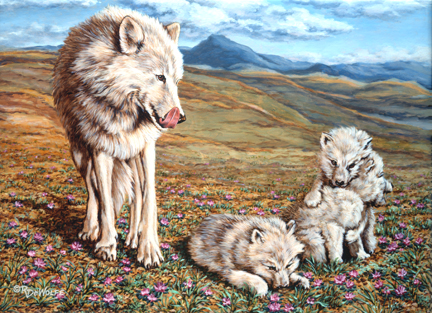
Arctic Summer

I created this painting when wildlife art was in high demand.  That wasn't the reason that I painted it, but  that market has fallen off drastically, so I paint much less wildlife now than I did then.  Art subjects are cyclical and like every business, you need to pay attention to what the market wants, at least some of the time.

The Arctic wolf lives in a tough environment, above the treeline.  Summers are very short there, and the tundra bursts into bloom for only a matter of weeks before temperatures begin to drop once more.  These pups are enjoying the mid-day sunshine while the mother wolf keeps a watchful eye on them.  There is little cover for them, should a predator happen by.

I painted this picture on stretched canvas using alkyd paints.  The painting measures 16 inches high by 22 inches wide.  I used a circular composition to direct the viewer's eye from the pup in the foreground, up to it's mates, and then to the mountain peak in the background before flowing to the she-wolf and back to the pups again.  The colour scheme is warm, which fortifies the feeling of mid-day sunshine.

You can find this painting and archival quality prints on paper or canvas at my web site www.richarddewolfe.com or my publisher's web site http://fineartamerica.com/profiles/richard-de-wolfe.html

Thursday, February 3, 2011

Painting Progression3 - Winter Really is a Blast!

I accentuate the shadowing on the scarf before adding a snowflake pattern to the material.  I continue to add detail, both light and shadow, on the fur, eyes and features of the polar bear's face.  More modelling is also added to the mitten.  The last thing that I do at this stage is to paint snowflakes in the air.  I add 'speedlines' to suggest a driving snow storm, in keeping with the title of the piece.  This also creates another illustion of animation in the painting.

Friday, January 28, 2011

Painting Progression - Winter Really is a Blast!


This is a new illustration image that I created for art licensing purposes.  I call this one "Winter Really is a Blast!"  It might do well on greeting cards or flags.  I am working on acid-free illustration board, using acrylic paint over a pencil drawing.  I have drawn the bear leaning into the picture on a bit of an angle to create a feeling of action.  In the first step I blocked in a simple background, delineating my subject and defining the design shape.  I start to block in some basic details with a mixture of ultramarine blue and lamp black on the scarf, touque and face.
Related Posts Plugin for WordPress, Blogger...