It is the beginning of boating season here in the Thousand Islands area on the St. Lawrence River. I love the water and boating, and soon I will be launching my own craft once again. The St. Lawrence Seaway has been open to shipping for several months now and will remain open until late autumn, alllowing ships from all over the world to reach ports all around the Great Lakes, deep in the interior of Canada and the United States .
This is a freighter from Europe that I saw several years ago as it was approaching the Thousand Island Bridge, between the U.S. mianland and Wellesley Island, N.Y. I loved the powerful mass of the ship, rising off of the water like some displaced, highrise architecture. I found the persepective leading to the arch span of the bridge in the distance to be an interesting design that appealed to me. The rolling clouds overhead seemed to enforce the energy and power of the massive ship churning upstream to Toronto, Detroit and perhaps many ports beyond.
Once I had worked out the composition to my satisfaction, I transferred the drawing to a 16" X 20" stretched canvas. The next step was to spray the drawing with fixative to prevent smearing when I started to paint.
After fixing the canvas, I applied a mixture of matt medium, burnt umber and cadmium red, to create a warm, earthy ground. This acrylic mixture is mostly matt medium to maintain a high degree of transparency so that my pencil drawing remains very visible. The warm colours will be complimentary to the cool blues of this waterscape. At this stage I am always eager to see some local colours applied to this ground.
Showing posts with label Canvas. Show all posts
Wednesday, May 25, 2011
Tuesday, April 26, 2011
Across the Miles - Step 5
I have now blocked in the entire canvas with colour. Finishing the snow-cover changes the mood and the look of the painting quite drastically. This gives me a really good idea of how the finished painting will look. The contours, light and shadows in the snow requires a subtle touch. It is important to create the illusion of an undulating plane, falling away from the foreground to the mountains in the distance. The roadway must also appear to 'sit' into the snow rather than on top of it. The fence now appears to stand up from the snow, three dimensionally.
Painting and refining the white lettering on the side of the postman's sleigh is meticulous work and requires patience. There is more work in this painting than I expected!
Labels:
Alkyd,
Animals,
Art Licensing,
Buildings,
Canvas,
Christmas,
Clouds,
Composition,
Demo,
Horses,
Nostalgia,
Sky,
Sleigh,
Snow,
Trees,
Victorian,
Winter
Monday, April 18, 2011
Across the Miles - Step 4
I continue the process of painting from back to front. I render the barn in the distance, then proceed to the farm house in the middle ground. Once again, I am choosing warm colours to keep this winter picture from becoming too 'cold'.
The next thing I tackle is the horse pulling the mail sleigh. This is a critical element in the painting, essentially the center of interest so I must take great care in how I paint it. I choose to make the horse black to create a high contrast with the white snow around it.
At this stage, I have left out the snow in the middle ground and started blocking in basic colour and detail on the rail fence in the foreground. This helps me to keep a visual balance throughout the painting. I have included the rail fence in the composition in order to add 'weight' to the lower portion and to guide the eye back toward the center of interest.
The next thing I tackle is the horse pulling the mail sleigh. This is a critical element in the painting, essentially the center of interest so I must take great care in how I paint it. I choose to make the horse black to create a high contrast with the white snow around it.
At this stage, I have left out the snow in the middle ground and started blocking in basic colour and detail on the rail fence in the foreground. This helps me to keep a visual balance throughout the painting. I have included the rail fence in the composition in order to add 'weight' to the lower portion and to guide the eye back toward the center of interest.
Tuesday, April 5, 2011
Across the Miles - Step 2
Now I start my under painting by priming the canvas with a mixture of acrylic made up of burnt sienna, cadmium red and a generous amount of mat medium to make it very transparent. I apply this evenly over the entire canvas to give it a warm ground for me to paint on.
Once that is dry, I use a mixture of the same colours, but with less medium and I wash in some tonal areas to establish some basic form. I work up some darker areas using the same colours and I delineate some details, such as the rail fence, sleigh, the horse and the buildings. I place dark tones on the fir trees to establish a pattern of snow on the upper side of the branches. Things are starting to take shape!
Saturday, April 2, 2011
Across the Miles
Here is the beginning of another new 'horse and sleigh' painting. These pictures are especially popular with my clients for such things as Christmas cards and puzzles. This one is called "Across the Miles". It is a depiction of the mailman making his delivery rounds by horse drawn sleigh. The scene is a snowy landscape in rural America, just before Christmas.
This canvas measures 16 inches high by 20 inches wide. Once I have worked out my initial drawing, I transfer it to stretched canvas, then spray it with workable fixative. Once that is done, I'm ready to start painting!
Thursday, March 24, 2011
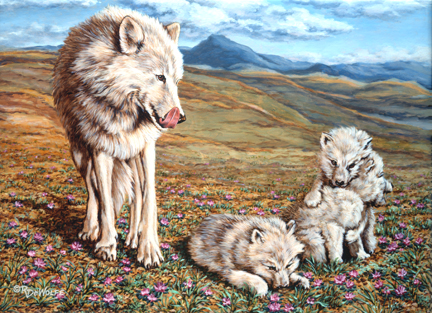
Arctic Summer
I created this painting when wildlife art was in high demand. That wasn't the reason that I painted it, but that market has fallen off drastically, so I paint much less wildlife now than I did then. Art subjects are cyclical and like every business, you need to pay attention to what the market wants, at least some of the time.
The Arctic wolf lives in a tough environment, above the treeline. Summers are very short there, and the tundra bursts into bloom for only a matter of weeks before temperatures begin to drop once more. These pups are enjoying the mid-day sunshine while the mother wolf keeps a watchful eye on them. There is little cover for them, should a predator happen by.
I painted this picture on stretched canvas using alkyd paints. The painting measures 16 inches high by 22 inches wide. I used a circular composition to direct the viewer's eye from the pup in the foreground, up to it's mates, and then to the mountain peak in the background before flowing to the she-wolf and back to the pups again. The colour scheme is warm, which fortifies the feeling of mid-day sunshine.
You can find this painting and archival quality prints on paper or canvas at my web site www.richarddewolfe.com or my publisher's web site http://fineartamerica.com/profiles/richard-de-wolfe.html
The Arctic wolf lives in a tough environment, above the treeline. Summers are very short there, and the tundra bursts into bloom for only a matter of weeks before temperatures begin to drop once more. These pups are enjoying the mid-day sunshine while the mother wolf keeps a watchful eye on them. There is little cover for them, should a predator happen by.
I painted this picture on stretched canvas using alkyd paints. The painting measures 16 inches high by 22 inches wide. I used a circular composition to direct the viewer's eye from the pup in the foreground, up to it's mates, and then to the mountain peak in the background before flowing to the she-wolf and back to the pups again. The colour scheme is warm, which fortifies the feeling of mid-day sunshine.
You can find this painting and archival quality prints on paper or canvas at my web site www.richarddewolfe.com or my publisher's web site http://fineartamerica.com/profiles/richard-de-wolfe.html
Wednesday, June 2, 2010
Confederation Park
I love to paint pictures of the Thousand Islands, the St. Lawrence River and boats. This painting is one that I did several years ago. It is the Confederation Boat Basin in Kingston, Ontario, Canada, not far from where I live. In the background is Kingston City Hall and Confederation Park. This is a great place to spend a summer evening near the water when the weather is warm. The view here is from the outer docks, looking back toward the lights of downtown Kingston. The sunset is rapidly fading into twilight and the ducks have settled for the night in the shelter of a boat slip in the foreground.The painting is sixteen inches wide by twenty inches high. It is painted on cotton canvas with alkyd paint. Prints are available.
Wednesday, March 31, 2010
Collecting the Sap
Here is another painting that I think is well suited to the season, here in Ontario. Our maple sugar and syrup making season has just ended for another year. The tradition of collecting sap from sugar maple trees is well known in eastern Canada and the north eastern USA. It is done in early spring when the sap stored in the roots of the maple tree begins to travel back up the trunks of these trees, to feed the buds that will soon blossom into leaves. Small holes are carefully drilled around the circumference of the tree and 'taps' or 'spiles' are driven into these holes to collect some of the sap as it flows upward. The sap, in turn, is allowed to drip into pails attached to the tree, or as is most common today, into a network of plastic tubing, which may run for miles to a central collection point. The sap must be boiled down quickly to avoid spoilage. It takes approximately eleven gallons of raw sap to produce one gallon of delicious maple syrup.For the most part, tractors and modern equipment have replaced the horses and sleighs that were traditionally used in collecting the sap for delivery to the 'sugar shacks' for the long process of boiling over a wood fire. If you look hard enough, it is still possible to find teams of horses, such as the Belgians pictured here, being used in the bush to bring tanks of sap to the wood fired evaporators and maple sugar shacks.
The title of this painting is 'Collecting the Sap'. This painting measures 18 inches by 24 inches. I painted it on stretched cotton canvas, using alkyd paints. Prints are available.
Tuesday, March 30, 2010
Madawaska Sunset
I thought this painting would be appropriate at this time of the year. We are down to the last days of March, spring is officially here, and the weather is definitely showing a warming trend. I painted this picture some years ago, when we owned a cottage on the Madawaska River, south of Algonquin Park, in Ontario, Canada. This is the view from that cottage, which sits high on the river bank, just to the right of this painting. It is a late afternoon picture and the sun is setting in the west. I loved the contrast of the warm light reflected in the water, surrounded by the cold blue of the melting ice in the foreground. The three Canada Geese tell a story of the changing seasons and the new life which will soon burgeon throughout the north.The title of this painting is 'Madawaska Sunset'. The painting measures 18 inches by 24 inches and it is painted in alkyd paint on stretched canvas. Like most of my paintings, prints are available in a variety of sizes.
Sunday, February 28, 2010
Sports Illustration
In honour of the 2010 Winter Olympic Games wrapping up today in Vancouver, I thought I would post an illustration that I was commissioned to paint for the Canada Games when they were held many years ago in Winnipeg, Manitoba. This illustration was painted on a fine weave cotton canvas with acrylic paints. It is hard to beat the intensity of colour that you can get with acrylics. Once again, this is a montage but this time there is a full background included. I enjoyed getting a feeling of animation in the water in the foreground and the flapping flags in the background. The colour scheme is vibrant because of the rich warm skin tones of the swimmer contrasting with the icy blue of the water around her.
Saturday, February 27, 2010
Auto Racing Montage
As I have mentioned before, throughout the 1970's, 80's and into the 1990's, I worked full-time in Advertising Illustration. Many of my clients were in the automotive field, such as Goodyear Tire. I produced a number of illustrations for Goodyear during that time period and this is one example of the work I did for them. What could be more fun to paint than a montage of racing machines diverging at dramatic angles?I tried to create an interesting and exciting composition that sweeps from back to front in a dynamic and dramatic curve. The rakish angle of the Goodyear Racer in the foreground seems to suggest thrust and speed. A montage must be carefully designed to work as an interesting unit without confusing the viewer. Often it is done as a vignette, so positive and negative shapes must be considered as well. The colour scheme must work as a unit and the design should carry the viewer's eye into the picture and keep it there. A variety of shapes and sizes of the elements within a montage are required to create visual interest. The whole thing can be a lot more difficult than you might think, at first glance.
I painted this illustration on a very fine woven primed canvas, using acrylic paint. Before I began to paint much detail over the finished drawing, I loosely painted a thin wash of colour over the general area of each individual scene, using the local colour of each one. After I painted the various elements in detail, I back-painted around the illustration with white gesso to softly define the shapes.
Sunday, January 31, 2010
This Time For Sure & Home For Supper
This one is called "This Time For Sure". I wanted to paint a typical day of pickup hockey, played by a bunch of country kids, on a frozen farm pond. When I was a kid, we played like this, sporting any equipment that we had. Many times we would not have skates available and we would play in our boots. The 'net' would usually be non-existant too, and we would improvise with a couple of blocks of firewood from home.Once again, this painting is done in alkyd oil on stretched canvas and measures 16 inches by 20 inches.
This one is called "Home For Supper". It features the same scene, but in the moonlight instead of mid-afternoon sunshine. Often, we played on the ice until the sun went down and supper time would arrive after dark. Finally realizing that we were late, we would drop our sticks and head for home , a hot meal and the warmth of a country kitchen. I painted this picture smaller than the others, only 11 inches by 14 inches. It is painted on canvas using acrylic paint.
Dreams of Glory
This is another of my series of paintings on the theme of country kids and hockey. This one gets the girls involved too. I call it "Dreams of Glory". When we were kids, it was common for the boys to dream of playing hockey in the NHL (National Hockey League) and the girls would dream of becoming Olympic figure skaters. The dog was usually happy to just live in the moment, jumping on anyone who happened to take a tumble!This painting measures 16 X 20 inches. It is painted on stretched canvas using alkyd paint. You can tell it is a good old frosty winter day in the country by the crystal blue sky and the hoar frost on the trees. The farm house and outbuildings in the background, along with the style of clothing worn by the kids, suggests the 1940's and 1950's. My favourite part of this painting is the low sheen of the ice surface, suggested by the soft reflections and the crisp skate marks that define the surface.
Friday, January 22, 2010
Wall of Fame
The month is flying by and I haven't found time to publish another post until now. This is one of a series of five paintings that I completed on the theme of nostalgic memories of winter skating in the country. The time period is the 1950's. In those days, hockey skates were made of uninsulated leather, dyed deep brown or black, or often a two-tone combination of the two. I call this painting "Wall of Fame". It represents the dreams and aspirations of many boys who grew up in rural areas, playing pick-up hockey on farm ponds and rivers, hoping some day to play in the NHL. In those days, the league consisted of only six teams and any school boy could name every player on every team.The painting is done on stretched canvas, rendered in alkyd paint, over an acrylic underpainting. It measures sixteen inches high by 20 inches wide. Since I no longer had my own skates from my boyhood years, I purchased this pair in a country auction to use as a model for the painting. I hung them on our barn wall and leaned a hockey stick that I had in the garage beside them to create an interesting grouping. The rough texture of the weathered barn boards make an interesting background for the polished leather surface of the skates. I added some snowflakes in the air to create an atmosphere of winter and a sense of animation in what otherwise is a still life.
Monday, November 16, 2009
Painting Progression-Between Nations-Step 10
Wednesday, September 30, 2009
Painting Progression-Between Nations-Step 6
Sunday, August 30, 2009
Painting Progression-Between Nations-Step 3
Friday, August 28, 2009
Painting Progression-Between Nations-Step 2
Wednesday, August 26, 2009
Painting Progression-Between Nations-Step 1
At this point, there is little to see, but I have begun priming my canvas with acrylic paint. I use a flat, bristle brush to apply a tone to the canvas. The colour I choose will affect the finished piece, acting as a ground for the colours that follow. I often use a warm earth tone mixture of burnt sienna and red. The other colour that I most often use is a blue-gray for a cooler ground. Here I have started with the warm, earth coloured mixture, which I have combined with gesso to fill the weave of the canvas. I cover the entire surface evenly and allow it to dry.
Subscribe to:
Posts (Atom)